
In short: A restaurant marketing plan does not start with the logo or with Instagram: it starts with a sheet showing the seven days of the week and two shifts, lunch and dinner, coloured in with the last eight weeks of bookings. Green if it filled up, amber if it was half full, red if it was painful to look at. That shows what no advertising dashboard will: where people are missing. Then you pick two gaps, decide what to say to those people, put the budget and the content there, and review it every week with holidays, fairs and conferences in front of you. One figure orders the rest: across 40 restaurants we manage, over thirteen weeks of summer 2026, a third of people decided between 4 and 8 pm, another third between noon and 4 pm, a quarter between 8 pm and midnight and only 11% before noon. You have to get there before that hour.
A marketing plan for a restaurant usually starts with the fun stuff: the logo, the Instagram, the video with epic music. And it usually ends up as a forty-page PDF that nobody ever opens again, not even the person who wrote it. Ours starts with something rather less sexy: a sheet with seven columns and two rows. The days of the week, lunch and dinner. Because before deciding how much to spend, you need to know which services really need people.
The service calendar
Take the bookings from the last eight weeks and colour in each service like you did at school: green if it filled up, yellow if it was half full, red if it was painful to look at. That's it, there's no more science to it. In ten minutes you have in front of you what no ads dashboard will ever show you: where people are missing.
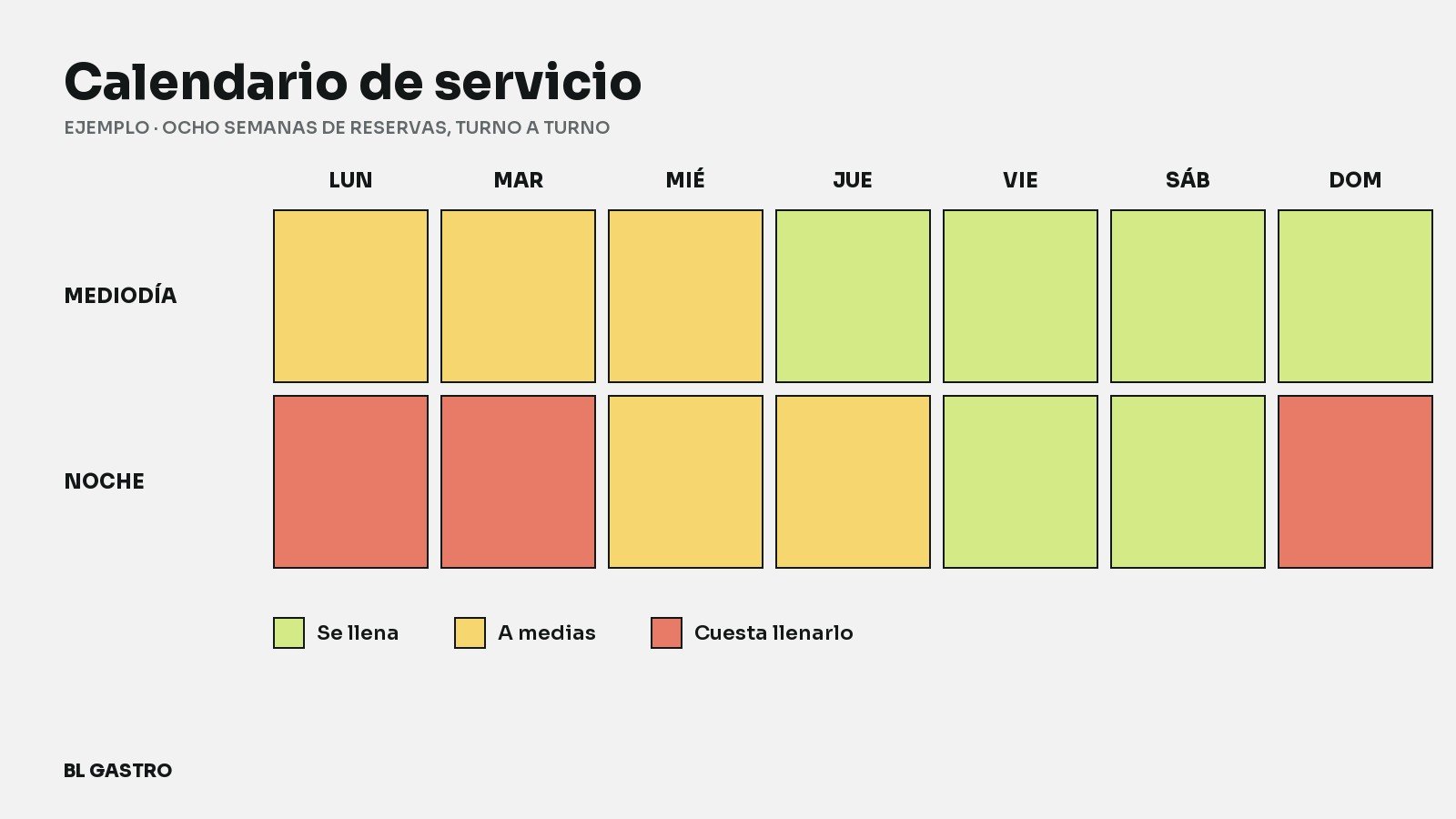
In this example, with colours made up for the occasion, Monday, Tuesday and Sunday dinners are in red. That's where the plan goes. Friday and Saturday already manage on their own.
What time people decide where to eat
We looked at this across 40 restaurants we manage, over thirteen weeks of summer 2026: what time people ask for directions, call or tap to book after seeing an ad.
- A third, between 4pm and 8pm (33%). Peak time runs from 7pm to 9pm.
- Another third, between midday and 4pm (31%), with the peak at one o'clock.
- A quarter, from 8pm to midnight (24%).
- Only 11% before midday. At nine in the morning nobody is thinking about your rice dish.
| Time slot | Actions | Peak | What to post or advertise before |
|---|---|---|---|
| Before noon | 11% | — | Not much: nobody is thinking about your paella at nine in the morning |
| Noon to 4 pm | 31% | 1 pm | The lunch menu, by eleven at the latest |
| 4 to 8 pm | 33% | 7 to 9 pm | Dinner: the dish, the terrace, the table that’s left |
| 8 pm to midnight | 24% | — | Whatever can still be booked tonight |
Sample: Google Ads campaigns of 40 restaurants managed by BL Gastro, thirteen weeks of summer 2026 (June–August). ‘Action’ = asking for directions, calling or tapping book after seeing the ad. These are our own figures, not an industry average.
In other words: dinner gets decided in the afternoon, and lunch on the fly (and hungry, which is how all the big decisions get made). If you post the menu at ten at night, or your ads only run once you've rolled up the shutter, you're late for both.
One caveat: this is the time people tap the ad, and it also depends on what hours the ad is shown. These are our own accounts and a single summer.
The plan, in five steps
1. Fill in the calendar with data, not from memory
From memory, every Tuesday was a disaster and every Saturday was glorious. The bookings usually tell a different story.
2. Pick two gaps
The two red services that hurt the most. If you pick seven, you haven't picked any.
3. Decide what you're going to say to those people
Don't talk to someone looking for lunch on a Wednesday about the twelve-course tasting menu. They've got forty-five minutes and a meeting at four.
4. Put the budget and the content there
The ads, scheduled for those days and those hours: we explain it in why Tuesdays can fill up just like Saturdays. The posts on social media, before the hour when people decide, not after. The rest of the channels, in order and with what each one costs, are in our guide to restaurant marketing.
5. Review it every week
Every Monday we cross-check the week's results against what's coming: bank holidays, festivals, fairs and conferences. Whatever hasn't worked gets changed that same week, not when the quarter ends and there's no fixing it.
The calendar for the year
The week is half the plan. The other half is the year: terrace season, the December company meals, the week of the conference that fills the neighbourhood's hotels with people wearing lanyards. We keep a calendar of the city's events and cross-check it against each restaurant, because the same Thursday isn't worth the same in February as in the week of a big conference. And which channel to switch on first for each of those gaps, with what each one asks of you in time and money, is in digital marketing for restaurants. And the five strategies that fill those gaps, in order and with a real case, in restaurant marketing strategies.
Frequently asked questions
Before making the plan
How much should a restaurant spend on marketing?
It depends on how many services need filling and on what each table brings in. That's why the calendar comes before the budget, not the other way round.
How often should the plan be reviewed?
Every week, whatever's running. Every season, the gaps you've chosen.
Does it work for a restaurant that already fills up at the weekend?
That's exactly the case for it: the plan doesn't touch what already works and concentrates on the services that don't.
Can I start without an agency?
Of course. You can build the calendar today with your own bookings. What's usually missing afterwards is the time to move the advertising and the content every week.