
In short: Google Ads for a restaurant means two bills: the ad spend paid to Google and the management fee paid to whoever runs the campaigns (with us, from €295 + VAT a month; spend is separate). Our clients invest from €220 a month; the usual range, and where it works best, is €350 to €600. With that, across 40 restaurants we manage over thirteen weeks of summer 2026, a click cost about 15 cents and each person who asked for directions, called or tapped book cost about 48 cents (half of the accounts between 34 and 56). Of every hundred people who do something, 87 ask for directions, 6 call, 4 tap book and 3 book on the website. To read the report you need three numbers: how many people did something, what each one cost and on which days. Only one in seven ‘conversions’ Google reports is a real action.
Asking how much Google Ads costs for a restaurant is like asking how much it costs to eat out: the usual answer is 'it depends', followed by a silence and a quote that turns up three days later. Here we're going to answer it with figures, the ones from the accounts we manage. And as a bonus, how to read the report afterwards without having to learn what the hell a CTR is.
How much Google Ads costs for a restaurant
First things first: there are two separate bills, and mixing them up is where almost every nasty surprise comes from.
- The ad spend, which goes to Google.
- The management fee, which goes to whoever runs the campaigns. In our case, from €295 + VAT a month; the ad spend is on top.
On the first, the short answer: we have clients spending anywhere from €220 a month up to €10,000. The norm, and where it works best for us, is between €350 and €600 a month. You don't need thousands to get started.
And this is what that money gets you, measured across 40 restaurants we manage over thirteen weeks of summer 2026:
- A click costs around 15 cents in the median account.
- Each person who asks for directions, calls or taps to book costs around 48 cents; in half the accounts, between 34 and 56. Less than a coffee, and they arrive hungry.
| Item | Figure | Source |
|---|---|---|
| Campaign management | from €295 + VAT a month | BL Gastro fee |
| Usual ad spend | €350–600 a month (clients from €220 up to €10,000) | BL Gastro accounts, 2026 |
| Typical monthly spend across accounts | median €360; half of the accounts between €238 and €632 | 43 accounts, 8 Jul – 6 Aug 2026 |
| Cost per click | about €0.15 | 40 restaurants, thirteen weeks, summer 2026 |
| Cost per action (directions, call, booking) | €0.48; half of the accounts between €0.34 and €0.56 | 40 restaurants, thirteen weeks, summer 2026 |
| Cost per action, late summer | median €0.54; half of the accounts between €0.29 and €0.67 | 43 accounts, 8 Jul – 6 Aug 2026 |
| What people do | 87% directions · 6% call · 4% book · 3% web booking | 40 restaurants, summer 2026 |
| ‘Conversions’ that are real actions | 1 in 7 | 40 restaurants, summer 2026 |
Sample: Google Ads campaigns of 40 restaurants managed by BL Gastro, thirteen weeks of summer 2026 (June–August). ‘Action’ = asking for directions, calling or tapping book after seeing the ad. These are our own figures, not an industry average.
Two caveats before anyone gets carried away: these are our own accounts and a single quarter, not a sector average. And mind what's being counted: someone asking for directions isn't sitting down yet.
What people do after seeing the ad
Out of every hundred people who do something, 87 ask for directions, 6 tap to call, 4 tap to book and 3 book on the website. It makes sense: a restaurant isn't a trainer shop, and hardly anyone 'buys' from the screen. That's why a report that only counts web bookings calmly leaves out almost everyone who actually came.
The three numbers that matter
1. How many people did something
Directions, calls and bookings. Not impressions, not clicks: people who intend to eat.
2. What each one cost
The spend divided by those people. It's the number you compare month on month, and the only one worth arguing over.
3. On which days
If it all lands on Saturday, you're paying for tables you already had. We explain it properly in why Tuesdays can fill up just like Saturdays. And what to say in the advert (a dish, a moment, the neighbourhood and the hour) is in restaurant adverts: 12 examples that work.
Ten you can ignore
Impressions, CTR, average position, quality score, impression share, bounce rate, total clicks, video views, optimisation score and plain 'conversions'. It's not that they're lies: it's that none of them tells you whether anyone walked through the door. They do look splendid on a slide, mind.
Conversions deserve a warning of their own. In the accounts we looked at, only one in seven 'conversions' Google records is someone asking for directions, calling or booking. Almost three in four are simply interactions with the ad. If your report boasts about conversions, ask which ones (and if they take a while to answer, that's a bad sign).
How to read the report in five minutes
- Find how many people asked for directions, called or booked.
- Divide what was spent by those people.
- Compare it with the previous month.
- Look at which days it happened on.
- Ask what's been changed in the campaign and why.
If you need a glossary to answer any of the five, the problem is the report's, not yours.
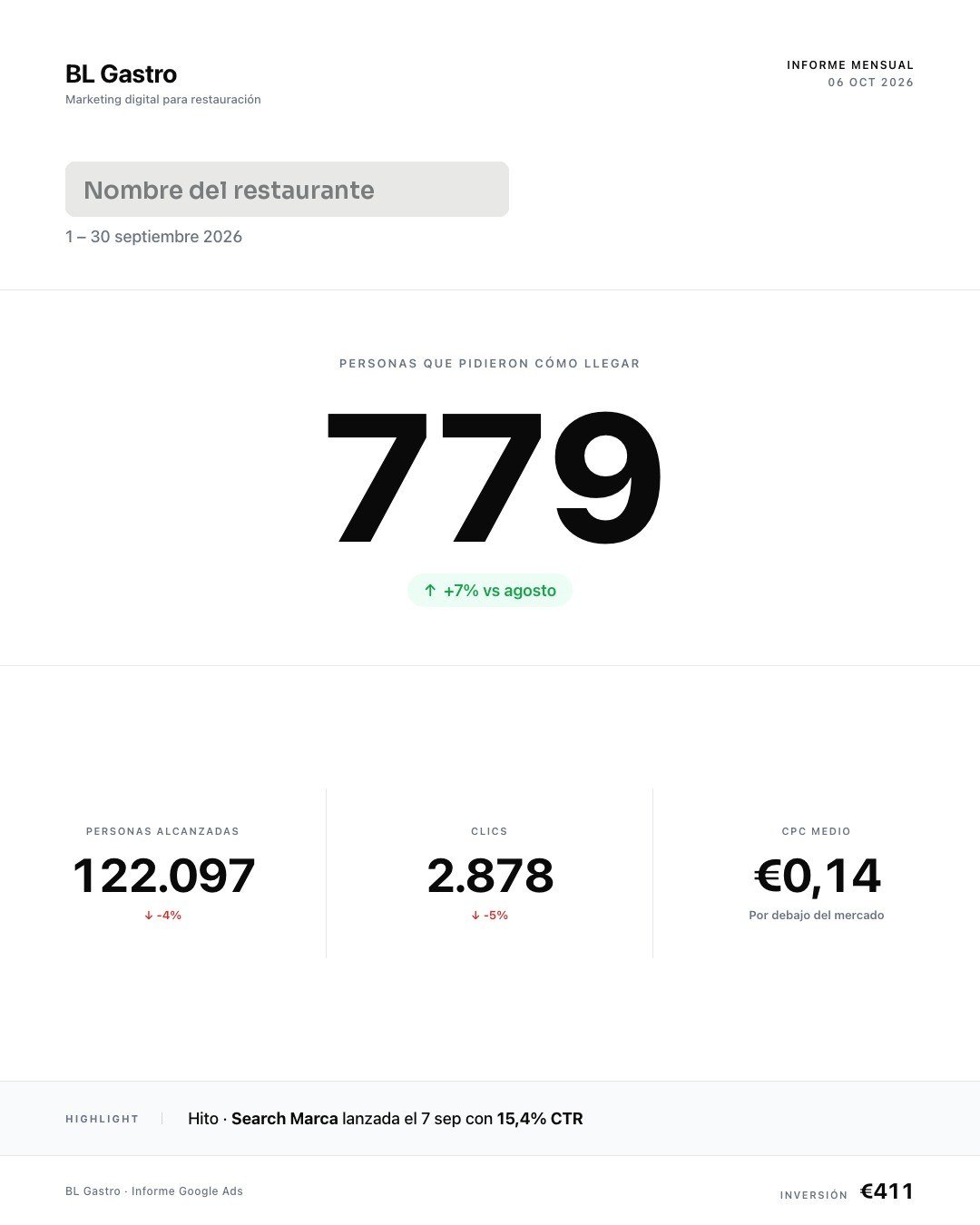
So it doesn't stay theoretical, here's one of ours, from September 2026, with the restaurant's name covered up: 779 people asked for directions on €411 of spend. At the top and in big type, what matters. The rest, underneath and in small print. And how to measure everything that is not Google Ads, by the same yardstick, is in our guide to restaurant marketing.
Frequently asked questions
Before investing in Google Ads
What's the minimum you have to spend a month?
There's no minimum. We have clients spending from €220 a month; the usual range is between €350 and €600.
Is the ad spend included in the management fee?
No. The ad spend is separate from our management fee, and we set it with you according to the restaurant and the goal.
How long does it take to get results?
The first clicks arrive the same day, but the system needs a few days of real data to fine-tune. Patience, but not too much of it.
How is it different from appearing on Google Maps for free?
Appearing for free depends on your Google Business Profile and your reviews: you don't pay per click, but you don't decide when you appear either. With Google Ads you pay per click and you're in charge of the budget, the hours and the area.